
MediaX: one video library for every camera on the vehicle
Low-latency video streaming for military vehicles to Defence Standard (DEF STAN) 00-082, with Real Time Streaming Protocol (RTSP), HTTP Live Streaming (HLS), Secure Reliable Transport (SRT) and Gigabit Ethernet Vision (GigE Vision) video in the same pipeline.
MediaX is a lightweight embedded video streaming library for defence systems. It sends and receives the video of a Generic Vehicle Architecture (GVA) platform: daylight, thermal and passenger cameras, discovered automatically and delivered with minimal delay. It also receives Internet Protocol (IP) cameras over RTSP, web streams over HLS, drone links over SRT and industrial GigE Vision cameras. It has a modern C++17 application programming interface (API), Qt6 wrappers for your graphical user interface (GUI) and a Python module for computer vision, and it uses the hardware you already have: Intel and AMD Video Acceleration API (VA-API), NVIDIA CUDA, the NVIDIA NVENC and NVDEC hardware video encoder and decoder, Jetson and Raspberry Pi.

All code is MISRA C++ 2023 Saftey Critical Standard compliant and issue free.
Which video standard do you need?
MediaX receives from more than the Defence Standard (DEF STAN) 00-082 network. This table compares the sources it handles.
| Video standard | Typical source | Direction | Transport | Discovery | Video formats | Status in MediaX |
|---|---|---|---|---|---|---|
| Video and Imagery over Ethernet (VIVOEX), DEF STAN 00-082 | Vehicle cameras, MediaX and ToolX senders | Send and receive | Real-time Transport Protocol (RTP) over User Datagram Protocol (UDP) multicast | Session Announcement Protocol (SAP) and Session Description Protocol (SDP), no configuration | Red, green, blue (RGB), YCbCr 4∶2∶2, Mono 8 and 16-bit, Joint Photographic Experts Group (JPEG), H.264, H.265, AV1 | Core |
| Real Time Streaming Protocol (RTSP) | Internet Protocol (IP) cameras and RTSP servers | Receive only | RTP over UDP, multicast or Transmission Control Protocol (TCP), controlled by RTSP | You give the URL | H.264 decoded today | Supported receiver |
| HTTP Live Streaming (HLS) | Web and content delivery network (CDN) streams, recorded and segmented video | Receive only | Hypertext Transfer Protocol (HTTP) or HTTP Secure (HTTPS), MPEG-2 transport stream segments | You give the URL | H.264 | Supported receiver |
| Secure Reliable Transport (SRT) | Drones and long-range radio or internet links | Send and receive, plus an RTP to SRT gateway | SRT over UDP, with retransmission inside a fixed latency window | You give the srt:// URL (caller, listener or rendezvous) | H.264 and H.265 in an MPEG-2 transport stream | Supported from 2.0.0-rc13 |
| Gigabit Ethernet Vision (GigE Vision) | Industrial and machine-vision cameras | Send (device emulator) and receive | GigE Vision Control Protocol (GVCP) control and GigE Vision Streaming Protocol (GVSP) streaming over UDP | SAP session name, or the device IP address | Mono8, Mono16, RGB8, YCbCr 4∶2∶2, Bayer 8-bit | Experimental |
When to use which
| If you need to... | Use | Why |
|---|---|---|
| Build a new vehicle or platform video network that every display can use without setup | Video and Imagery over Ethernet (VIVOEX) | The Session Announcement Protocol (SAP) and Session Description Protocol (SDP) announce every camera, so a new camera appears on every display with no configuration. This is what Defence Standard (DEF STAN) 00-082 requires. |
| Carry thermal imagery without losing radiometric detail | VIVOEX with Mono 8 or Mono 16-bit | Uncompressed monochrome keeps every pixel and adds no encoding delay. |
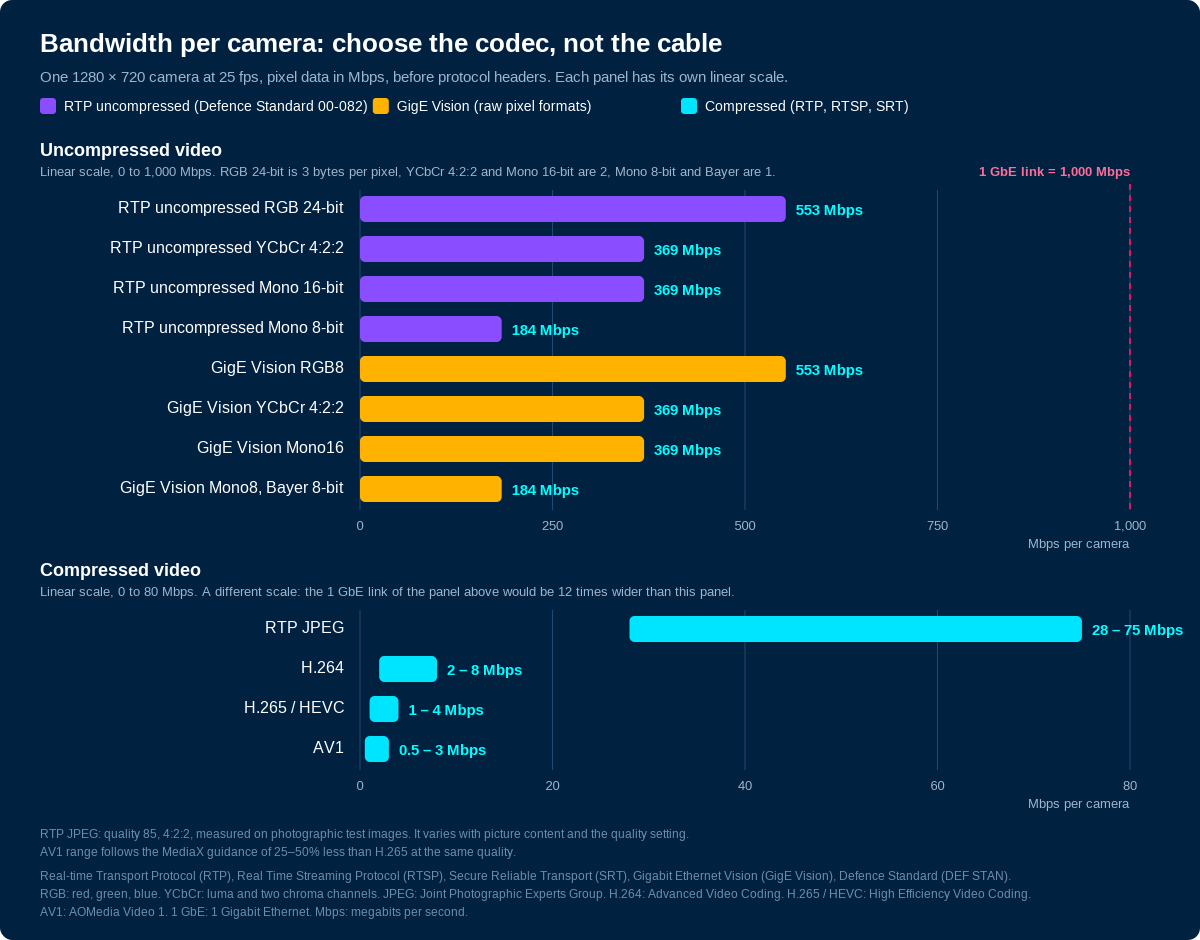
| Fit many cameras on a standard 1 Gigabit Ethernet (1 GbE) backbone | VIVOEX with H.264 or H.265 | A compressed 720p camera at 25 frames per second needs a few megabits per second (Mbps), against hundreds of Mbps uncompressed. |
| Bring an existing Internet Protocol (IP) camera into the same pipeline | Real Time Streaming Protocol (RTSP) | MediaX pulls the camera over RTSP and decodes it with the same depayloaders as native streams. |
| Show a web or content delivery network (CDN) stream, or a playlist of segments | HTTP Live Streaming (HLS) | MediaX plays a master or media playlist and follows live playlist refreshes. Expect more delay than the Real-time Transport Protocol (RTP), because the video travels in segments. |
| Use an industrial camera that speaks Gigabit Ethernet Vision | GigE Vision | MediaX discovers and receives GigE Vision Streaming Protocol (GVSP) frames directly. Validate against your own cameras first: support is experimental. |
| Carry encrypted, loss-tolerant video across a radio or wide-area link, such as a drone video link | Secure Reliable Transport (SRT) | Lost packets are recovered by retransmission inside a fixed latency window of 100 to 500 milliseconds, and Advanced Encryption Standard (AES) encryption is optional. |
Video and Imagery over Ethernet (VIVOEX), Defence Standard 00-082
Video and Imagery over Ethernet (VIVOE) is the video part of Defence Standard (DEF STAN) 00-082. It sits alongside the Data Distribution Service (DDS, DEF STAN 23-009) in the Generic Vehicle Architecture (GVA). MediaX is the Astute Systems implementation, used as the video backbone of GVA and Generic Soldier Architecture (GSA) platforms.
- Discovery: every sender announces itself with the Session Announcement Protocol (SAP), and the Session Description Protocol (SDP) data in each announcement carries the resolution, codec and multicast address. A display never needs an Internet Protocol (IP) address typed in.
- Transport: Real-time Transport Protocol (RTP) over User Datagram Protocol (UDP) multicast.
- Formats: uncompressed red, green, blue (RGB), YCbCr 4∶2∶2, Mono 8 and Mono 16-bit (Request for Comments (RFC) 4175), RTP Joint Photographic Experts Group (JPEG) video (RFC 2435), plus H.264 (Advanced Video Coding), H.265 (High Efficiency Video Coding, HEVC) and AV1 (AOMedia Video 1).
- Acceleration: Video Acceleration API (VA-API) on Intel and AMD, the NVIDIA NVENC and NVDEC hardware video encoder and decoder, the Jetson Multimedia API, Video4Linux2 (V4L2) on Raspberry Pi, and OpenH264 in software on any central processing unit (CPU).
- Fielded: deployed on the UK Boxer Mechanised Infantry Vehicle (MIV) programme.
Best for: new platforms where you control the cameras and the displays.
Real Time Streaming Protocol (RTSP)
Pull video from Internet Protocol (IP) cameras and Real Time Streaming Protocol (RTSP) servers (Request for Comments (RFC) 2326). RTSP only negotiates and controls the session. The video travels as ordinary Real-time Transport Protocol (RTP), so the standard MediaX depayloaders decode it.
- User Datagram Protocol (UDP), multicast and Transmission Control Protocol (TCP) interleaved transport, with automatic fallback when the server rejects UDP.
- Basic and Digest authentication. Credentials are sent only to the host in the URL and are never logged.
- Automatic reconnect with exponential backoff, RTP Control Protocol (RTCP) receiver reports and keep-alive.
- A liveness probe tells you whether a camera is up without opening a decoder.
- Compressed frames can be forwarded or recorded to Matroska.
- Qt6
QtRtspDepayloaderthat never blocks the graphical user interface (GUI) thread, a Python module, and theqt6-rtsp-playerexample.
Limits: receiver only. H.264 is decoded today; H.265 and AV1 sessions are parsed but need a decoder backend. RTSP over Transport Layer Security (RTSPS), audio, Secure RTP (SRTP) and an RTSP server are not implemented.
HTTP Live Streaming (HLS)
Play an HTTP Live Streaming (HLS) .m3u8 playlist, master or media, whose segments are MPEG-2 transport streams (Moving Picture Experts Group) carrying H.264.
- Redirects are followed and live playlists are refreshed automatically.
- A variant is selected by preferred resolution.
- Playback runs at the stream rate through the same
Receive()interface as the other depayloaders. - Also available in the
qt6-rtsp-playerexample, with Motion JPEG (MJPEG) and Joint Photographic Experts Group (JPEG) snapshot cameras.
Limits: audio, encrypted (EXT-X-KEY) and fragmented MPEG-4 (EXT-X-MAP) streams are not supported. Segment-based delivery adds delay compared with the Real-time Transport Protocol (RTP).
Secure Reliable Transport (SRT)
Secure Reliable Transport (SRT) is a protocol over User Datagram Protocol (UDP) that recovers lost packets by retransmission within a fixed latency window. It suits a drone or long-range radio link: a round trip of tens of milliseconds, bursts of loss, and a ground station that needs the picture a few hundred milliseconds after it was taken. Available from MediaX 2.0.0-rc13.
- Latency: low and configurable from 100 to 500 milliseconds, constant while the link is healthy. A
ForDroneLink()preset picks it from the round-trip time. - Reliability: lost packets are requested again until they could no longer arrive in time, then skipped, so the stream never stalls. The decoder waits for the next key frame, so a damaged picture is never shown.
- Security: optional Advanced Encryption Standard (AES) encryption with 128, 192 or 256-bit keys and a passphrase (OpenSSL).
- Video: H.264 or H.265 in an MPEG-2 transport stream (Moving Picture Experts Group), in both directions.
- Modes: caller, listener and rendezvous. A listener accepts the next caller and a caller reconnects, so a drone that flies out of range and back resumes by itself.
- Native: implemented in MediaX with no dependency on libsrt, and interoperates with libsrt, ffmpeg, ffplay, VLC, OBS and
srt-live-transmit. - Real-time Transport Protocol (RTP) to SRT gateway: carries H.264 and H.265 between a stream announced with the Session Announcement Protocol (SAP) and SRT without decoding or re-encoding, so it costs very little processing and adds no picture latency of its own.
- Tooling:
SrtDepayloaderandSrtTransmitterin C++,QtSrtDepayloaderfor Qt6 graphical user interface (GUI) programs, andsrt-receiveandsrt-transmitcommand-line examples.
Limits: live mode only. There is no forward error correction or connection bonding, a running connection is not rekeyed (reconnect to rotate the key), audio is ignored, and rendezvous mode has been tested only against MediaX itself.
Gigabit Ethernet Vision (GigE Vision)
Industrial cameras that speak GigE Vision (Automated Imaging Association, AIA, version 2.x) join the same pipeline as every other source.
- GigE Vision Control Protocol (GVCP) device discovery and control on User Datagram Protocol (UDP) port 3956.
- GigE Vision Streaming Protocol (GVSP) streaming over standard Gigabit Ethernet, with a default 1456-byte packet size and jumbo frames up to 9000 bytes.
- Generic Interface for Cameras (GenICam) Extensible Markup Language (XML) device description and standard feature naming.
- Pixel formats Mono8, Mono16, RGB8 (red, green, blue), YCbCr 4∶2∶2 and 8-bit Bayer (GR, RG, GB, BG) with Bayer to RGB conversion.
- A device emulator, so you can test displays without a camera, and discovery by Session Announcement Protocol (SAP) session name.
- Frames can be shown in a gva-designer application with the GigeVideoWidget.
Status: experimental. Validate it against your own cameras before relying on it for production.
Key features
- Defence Standard 00-082: Implements Video and Imagery over Ethernet (VIVOE) for the Generic Vehicle Architecture (GVA) and Generic Soldier Architecture (GSA), including Session Announcement Protocol (SAP) and Session Description Protocol (SDP) discovery.
- Many sources, one pipeline: Receives Real Time Streaming Protocol (RTSP) cameras, HTTP Live Streaming (HLS) streams, Secure Reliable Transport (SRT) drone links and Gigabit Ethernet Vision (GigE Vision) industrial cameras alongside native vehicle streams.
- Low latency: Built for real-time vehicle displays where a late frame is a wrong decision.
- Hardware acceleration: Video Acceleration API (VA-API) on Intel and AMD for H.264, H.265, AV1 and JPEG, the NVIDIA NVENC and NVDEC hardware video encoder and decoder, the Jetson Multimedia API, Video4Linux2 (V4L2) on Raspberry Pi, and Advanced Vector Extensions 2 (AVX2) and CUDA colour conversion, with OpenH264 as the software fallback.
- C++17, Qt6 and Python: Send or receive in a few lines. The Qt6 wrappers never block the graphical user interface (GUI) thread, and the Python module feeds computer vision and artificial intelligence (AI) pipelines.
- MISRA C++:2023 compliant: The library code is lint-clean against the Motor Industry Software Reliability Association (MISRA) C++:2023 coding standard, checked with THEMIS Lint, and every deviation is justified in the source. Video pipelines handle untrusted network input at high rates, so this matters.
- Works with DDS: Sits beside the Data Distribution Service (DDS, DEF STAN 23-009) to form the communication and media backbone of a platform.
- Linux, Jetson and Android: Ubuntu 24.04 and 26.04, AlmaLinux 9 and 10, Raspbian 12, NVIDIA Jetson and Android.
Get started in a few lines
#include "rtp/rtp.h"

int main() {
  mediax::RtpSapTransmit<mediax::rtp::uncompressed::RtpUncompressedPayloader> rtp(
      "239.192.1.1", 5004, "my-stream", 640, 480, 30, "RGB24");
  std::vector<uint8_t> &data = rtp.GetBufferTestPattern();
  for (int i = 0; i < 1000; i++) rtp.Transmit(data.data(), false);
}
To change the codec, change the payloader class. For H.264 with the Video Acceleration API (VA-API) use mediax::RtpH264VaapiPayloader and the "H264" encoding.
See every stream on your network with ToolX

GVA ToolX is the graphical tool for MediaX. It discovers every stream announced on the network, plays any of them with one click, and generates synthetic video to test network performance and your human machine interface (HMI) before the hardware exists. It also includes live Session Announcement Protocol (SAP) monitoring, a Simple Network Management Protocol (SNMP) browser for the Video and Imagery over Ethernet (VIVOE) Management Information Base (MIB), recording and Gigabit Ethernet Vision (GigE Vision) camera support. No configuration is needed.